An AI visibility audit checks how AI answer engines—such as ChatGPT, Gemini, and Google AI Mode—respond to the questions your buyers ask: whether the answers mention your brand, which competitors they name instead, and which sources they cite.
A good audit should leave you with more than a score. You should know which questions mention your brand, which sources appear in the answers, and what deserves a closer look.
- Start with five specific buyer questions in one market and one language.
- Check answer coverage before reading the score: visibility is mentions divided by completed answers.
- A mention and a citation are different signals. Read the cited pages before treating anything as fact.
- Turn one relevant competitor-only answer into an evidence-backed brief, not a pile of new pages.
- Keep the scope identical when you rerun, or the comparison isn't fair.
This guide walks through Trace’s free audit, from choosing your questions to creating an evidence-backed brief. Start with a narrow, useful baseline. You can expand your research later.
Five questions · two competitors · three engines · two answers per question per engine = 30 answer checks. Choose one market, one language, and up to three topics. Up to three free audits per 24 hours. No card and no upgrade required to read your report, answers, or sources.
Screenshots show Trace’s actual interface. Alder, Summit, and Roam are fictional names entered manually for the setup example; no audit was run for those brands.
1. Enter your website and choose a market
Open Trace’s free audit and enter your website. Use Continue for website-assisted setup, or Set up manually to enter the details yourself.
Next, select the market and language your buyers use. For example, a US-focused English-language business can start with United States and English. These choices carry into the audit; they are not extra paid selections.
Choose one audience for this baseline. Combining several markets into five questions makes the results harder to interpret. Also check the wording: questions are sent exactly as written, so selecting a language is not a substitute for reviewing the questions in that language.
2. Review your brand and competitors
In website-assisted setup, Trace reads your website and suggests a profile, competitors, topics, and questions. Treat that as a starting point. On Does this sound like you?, check the brand name, description, category, and audience. Manual setup gives you the same editable fields.
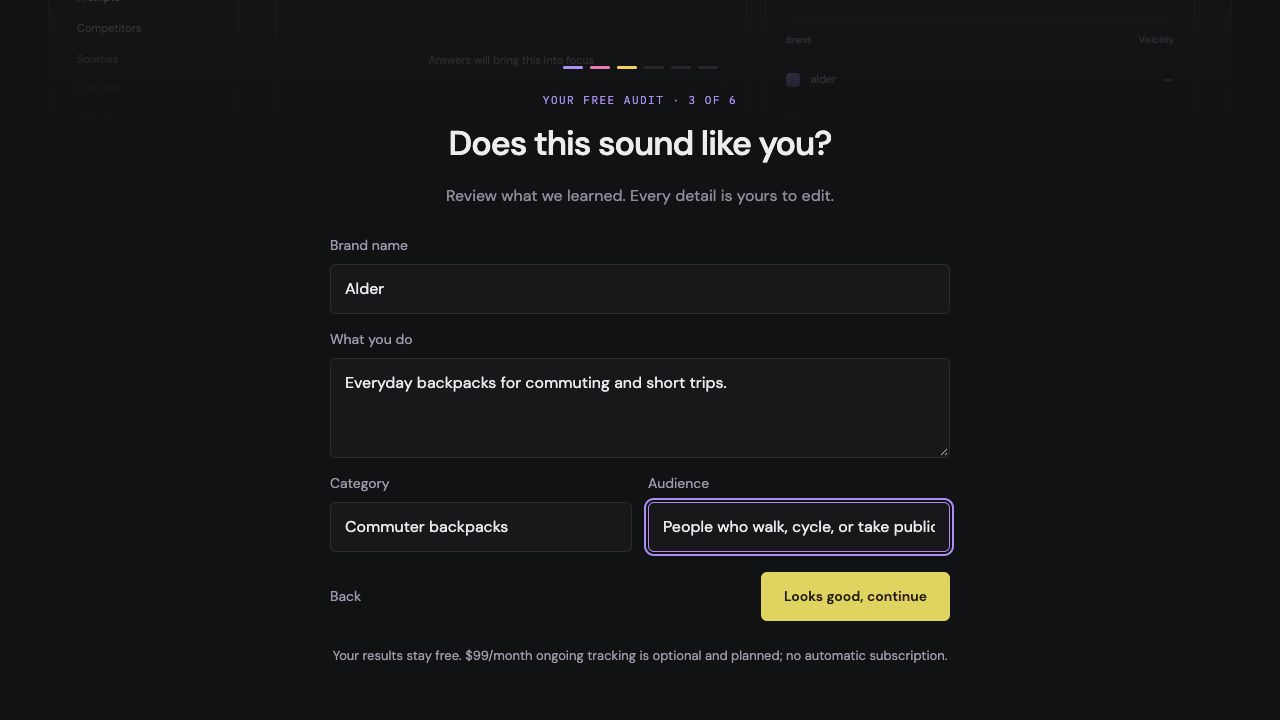
Then choose two competitors your buyers would realistically compare with you. Suggestions are not verified competitors. Replace a broad category leader with a closer alternative when that makes the comparison more useful. Use distinct, recognizable brand names.
3. Choose topics, then write five buyer questions
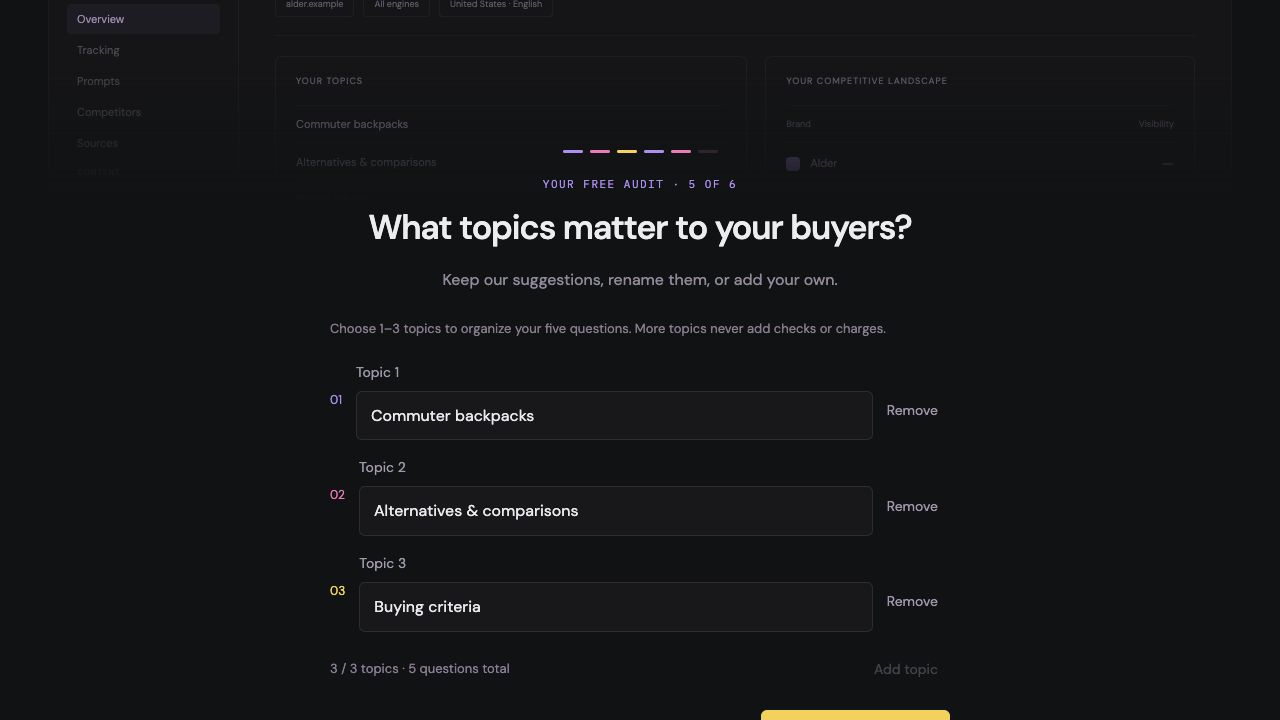
Topics organize the audit. Choose one to three, rename the suggestions, or remove anything irrelevant. For a commuter backpack brand, “Commuter backpacks,” “Alternatives & comparisons,” and “Buying criteria” are reasonable starting buckets. More topics do not add more checks: you still have five questions total.
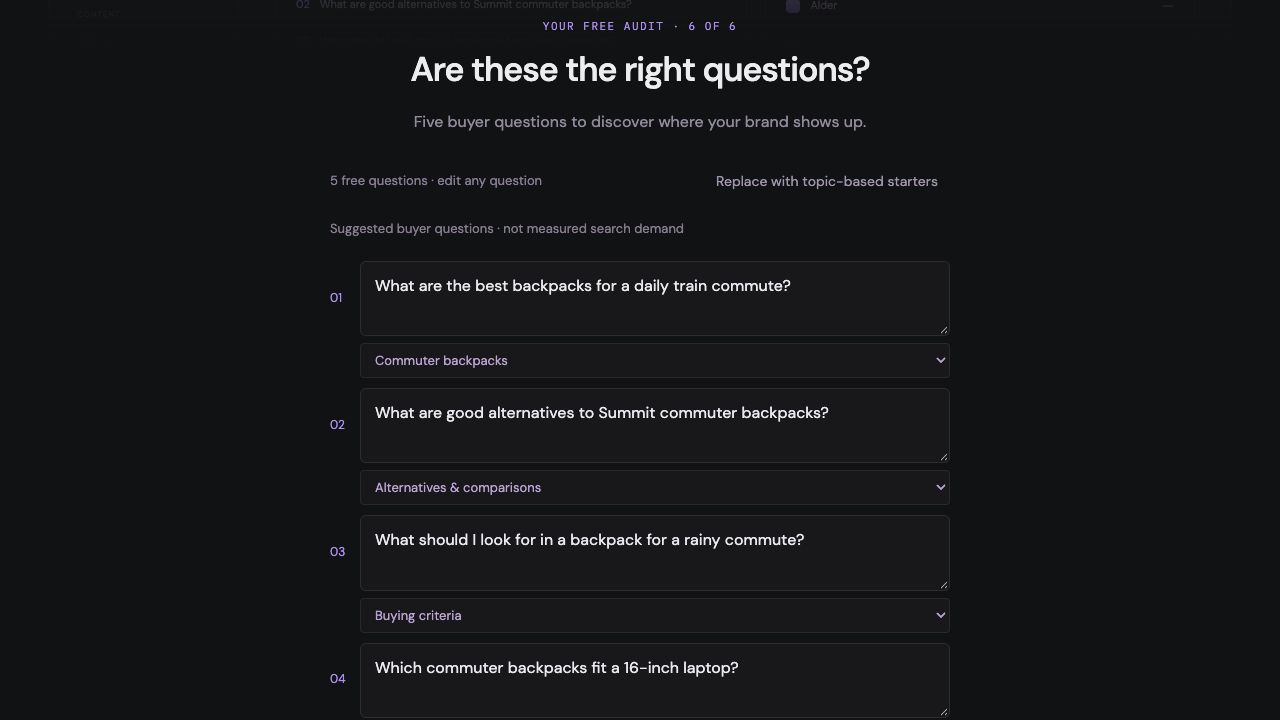
On Are these the right questions?, rewrite generic starters into questions a buyer might actually ask. A useful mix includes discovery, comparison, and a specific need:
- What are the best backpacks for a daily train commute?
- What are good alternatives to Summit commuter backpacks?
- What should I look for in a backpack for a rainy commute?
- Which commuter backpacks fit a 16-inch laptop?
- How do Summit and Roam compare for daily commuting?
Keep broad discovery questions unbranded if you want to see whether your brand appears without being named in the question. Branded comparison questions answer a different question: how the brands are described when they are explicitly included. Interpret those results separately.
4. Run the audit and check coverage first
Review the scope and select Run free audit. Trace checks your five questions twice on each of ChatGPT, Gemini, and Google AI Mode. Results appear as answers arrive; you do not need to wait for every check to finish to start reading.
Before interpreting the score, look at how many answers completed and whether any checks were unsuccessful. Partial coverage means you have less evidence. It does not mean the missing answers omitted your brand.
Brand visibility is the share of completed answers that mention your brand by name. For example, 12 mentions in 30 completed answers is 40%. If only 20 answers completed and 12 mentioned you, that view is 60%—a different denominator, not necessarily an improvement.
A mention and a citation are different signals. An answer can name your brand without linking to your website, or cite a page without recommending your product. Competitor visibility percentages can overlap because one answer can mention several brands.
5. Read the answers behind one meaningful gap
Use Answers & sources to inspect the question coverage and cited domains (Trace’s sources explorer goes deeper in a workspace). Expand a question and read the actual answers. Use the engine filter when you want to examine one engine rather than the combined view.
In Opportunities, look for answers that mention competitors without your brand. Trace’s strongest observed gap is ranked by gap count, then engine coverage in your selected view. That is a research priority, not an estimate of lost revenue.
Before creating content, check three things:
- Relevance: Is this a question your intended buyer asks, and can your product genuinely meet the need?
- Evidence: What did the answer say, and do its cited pages actually support the claims?
- Existing coverage: Do you already have a page that answers this well? It may need a focused update rather than a new article.
A competitor-only answer does not prove your website is missing a page. A citation does not certify that the answer is correct. Open the source before treating pricing, limits, or comparisons as facts.
6. Carry the finding into a brief
When an opportunity is relevant, select Create my brief. Trace opens a free workspace with the question, supporting answers, and sources attached. This action does not start an AI generation or a subscription.
Review your brand facts, audience, and voice before drafting. Decide what the piece should clarify and what it should avoid claiming. Your first successful AI draft generation is included once per workspace. Review important claims against their original sources, edit the copy, and export it when you are ready. Publishing is manual.
If the audit finds no competitor-only gaps, do not manufacture one. Review the answers for unclear positioning, unsupported claims, or questions that were too broad to be useful.
7. Keep a baseline you can compare fairly
Record the questions, engines, market, language, date, and successful-answer count. When you compare a later run, keep that scope consistent. A changed question set or a partially completed run can shift the score without reflecting a real change in visibility.
Answers vary between runs. An increase after a content update is an observation, not proof that the update caused it.
Ongoing tracking is part of Trace’s $99/month workspace, billed monthly with no overage charges. You don’t need it to get started: the free audit establishes a baseline and creates your first evidence-backed brief, and running an audit never starts a subscription.
Frequently asked questions
What is an AI visibility audit?
An AI visibility audit records how AI answer engines respond to a fixed set of buyer questions. For each answer it notes whether your brand is mentioned, which competitors appear, and which websites are cited, so you can see where you show up, where you don’t, and why.
How many questions should an AI visibility audit include?
Start small and specific. Five well-chosen buyer questions in one market and language give you a baseline you can actually read. Mix discovery, comparison, and specific-need questions, and keep broad discovery questions unbranded.
What is the difference between a brand mention and a citation?
A mention means the answer names your brand. A citation means the answer links to a source, such as your website or a review site. You can be mentioned without being cited, or cited without being recommended, so track them separately.
How do I compare audits over time?
Keep the questions, engines, market, language, and topics the same, and note how many answers completed. AI answers vary between runs, so treat a change after a content update as an observation rather than proof of cause.
Is Trace’s AI visibility audit free?
Yes. The free audit covers five questions, two competitors, and three engines (30 answer checks), with no card required. You can run up to three free audits per 24 hours and read the full report, answers, and sources.
Choose five relevant questions. Read the answers. Check the sources. Pick one justified next step.
Run your free audit →